
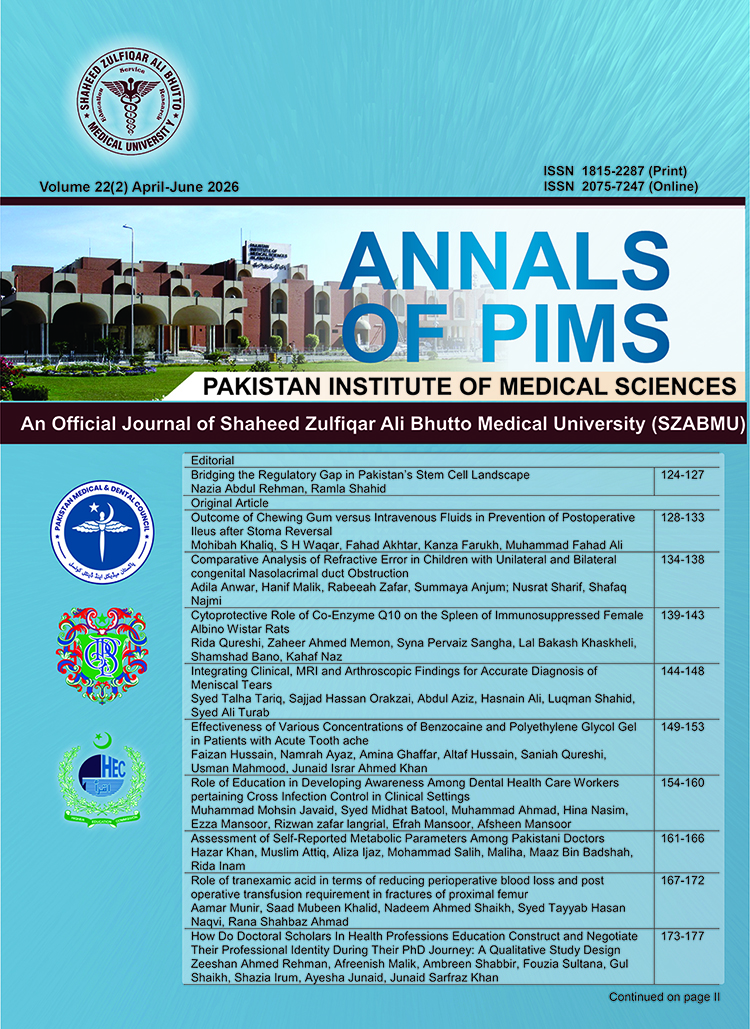
Effectiveness of Various Concentrations of Benzocaine and Polyethylene Glycol Gel in Patients with Acute Tooth ache
DOI:
https://doi.org/10.48036/apims.v22i2.1656Abstract
Objective: To find out the reduction in pain in one hour, upon application of topical Benzocaine gels, with 10% and 20% concentrations, for toothache due to irreversible pulpitis.
Methodology: This comparative study was conducted in Department of Operative Dentistry, Pakistan Institute of Medical Sciences Islamabad from Dec 2018 to Feb 2020. Sample of 200 in each group, 10% Benzocaine group, 20% Benzocaine group and polyethylene glycol gel group was achieved via stratified random sampling. Patients without any systemic disease, 15 years or older reported with toothache due to irreversible pulpitis in one permanent maxillary or mandibular tooth with an open cavity were included. The intensity of endodontic pain was evaluated by the Visual Analogue Scale (VAS). The ethical committee of PIMS/SZABMU approved the study and the informed consent was taken from participants after a diagnosis of irreversible pulpitis was made with cold test.
Results: Out of 600 patients, males were 254 and females were 346. Patients with moderate severity of pain upon arrival for dental treatment were 404, while 196 had severe pain. Chi-square test revealed that there was a significant difference between the levels of pain after one hour among the three groups (P=< 0.001). Similarly, chi-square revealed that there was a significant difference between the levels of pain relief among the three groups after one hour (P=<0.001).
Conclusion: Benzocaine gel (20%) showed more effective results as compared to the 10% benzocaine gel in patients with tooth ache. Benzocaine, in both concentrations, is more effective than Polyethylene Glycol.
Downloads
Published
Issue
Section
License
Copyright (c) 2026 Faizan Hussain, Namrah Ayaz, Amina Ghaffar, Altaf Hussain, Saniah Qureshi, Usman Mahmood, Junaid Israr Ahmed Khan

This work is licensed under a Creative Commons Attribution-NonCommercial 4.0 International License.
This is an Open Access article distributed under the terms of the Creative Commons Attribution License (https://creativecommons.