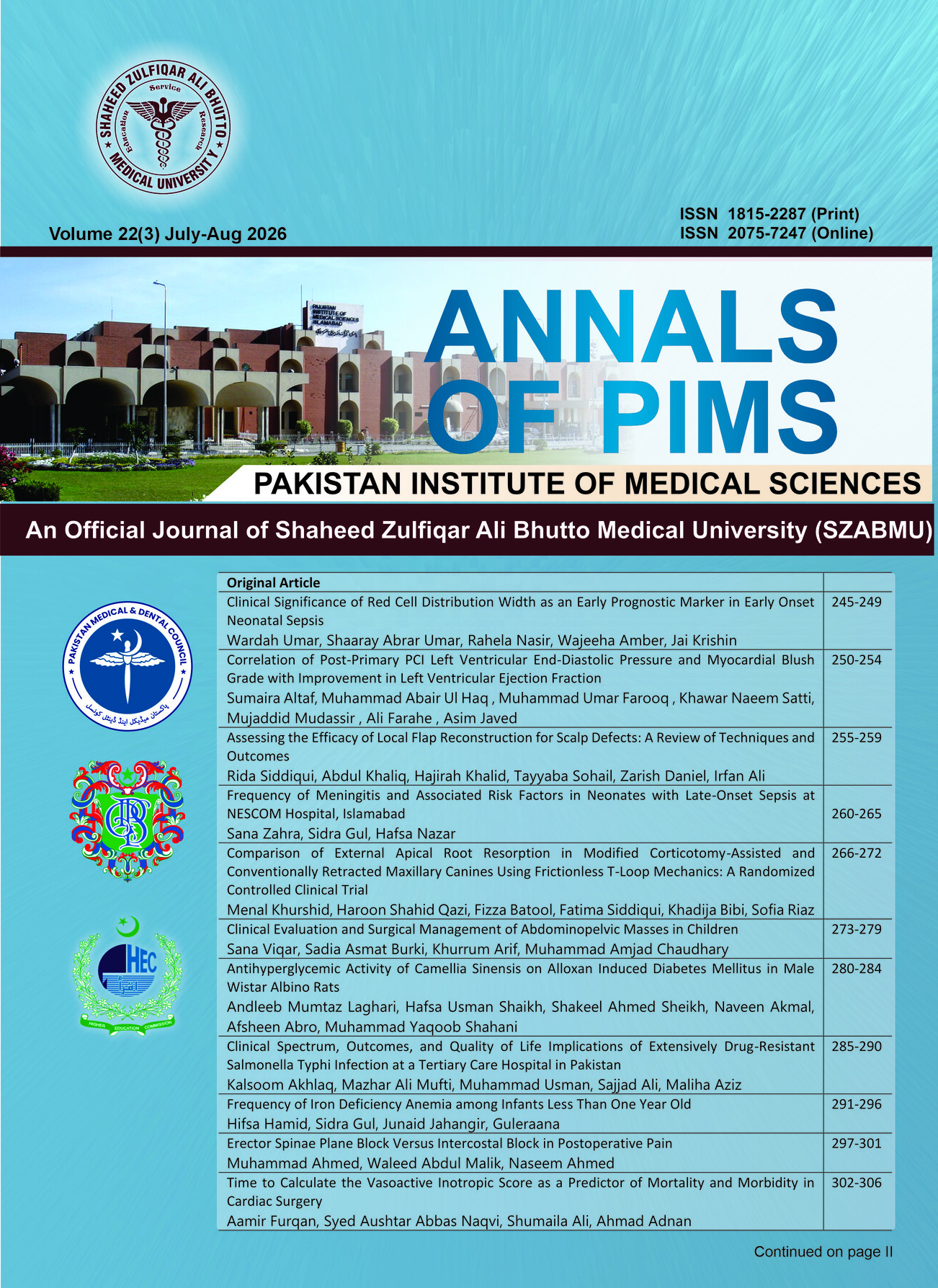
Assessing the Efficacy of Local Flap Reconstruction for Scalp Defects: A Review of Techniques and Outcomes
DOI:
https://doi.org/10.48036/apims.v22i3.1637Keywords:
Scalp reconstruction, aesthetic outcomeAbstract
Background: Scalp reconstruction presents unique challenges due to limited tissue elasticity, aesthetic importance, and the need to protect underlying structures. Among various reconstructive options, local flaps remain a cornerstone technique, offering vascular reliability and tissue compatibility. This study aimed to assess the efficacy and outcomes of local flap reconstruction for scalp defects compared with other reconstructive methods.
Methods: A prospective observational comparative study was conducted on 100 patients presenting with scalp defects of varying etiology, including post-traumatic, post-oncologic, and infective causes. Participants were treated using either local flaps or other reconstructive techniques. Data were analyzed using SPSS version 26, with normality assessed by the Shapiro–Wilk test. The Mann–Whitney U test and Chi-square test were applied for group comparisons, while Spearman’s correlation evaluated associations between defect size and postoperative outcomes.
Results: Local flaps were used in 45 (45%) cases, regional flaps in 24 (24%), and free flaps in 31 (31%) cases. The overall flap viability was 80 (80%), with 4 (4%) cases of complete failure. Postoperative complications included infection in 23 (23%) patients, wound dehiscence in 16 (16%), and hematoma in 4 (4%) .
Conclusion: Local flap reconstruction remains a safe, efficient, and aesthetically favorable technique for scalp defect repair, providing outcomes comparable to more complex methods while minimizing operative time and morbidity.
Keywords: Scalp reconstruction, local flap, aesthetic outcome, wound healing, reconstructive surgery
Downloads
Published
Issue
Section
License
Copyright (c) 2026 Rida Siddiqui, Abdul Khaliq, Hajirah Khalid, Tayyaba Sohail, Zarish Daniel, Irfan Ali

This work is licensed under a Creative Commons Attribution-NonCommercial 4.0 International License.
This is an Open Access article distributed under the terms of the Creative Commons Attribution License (https://creativecommons.