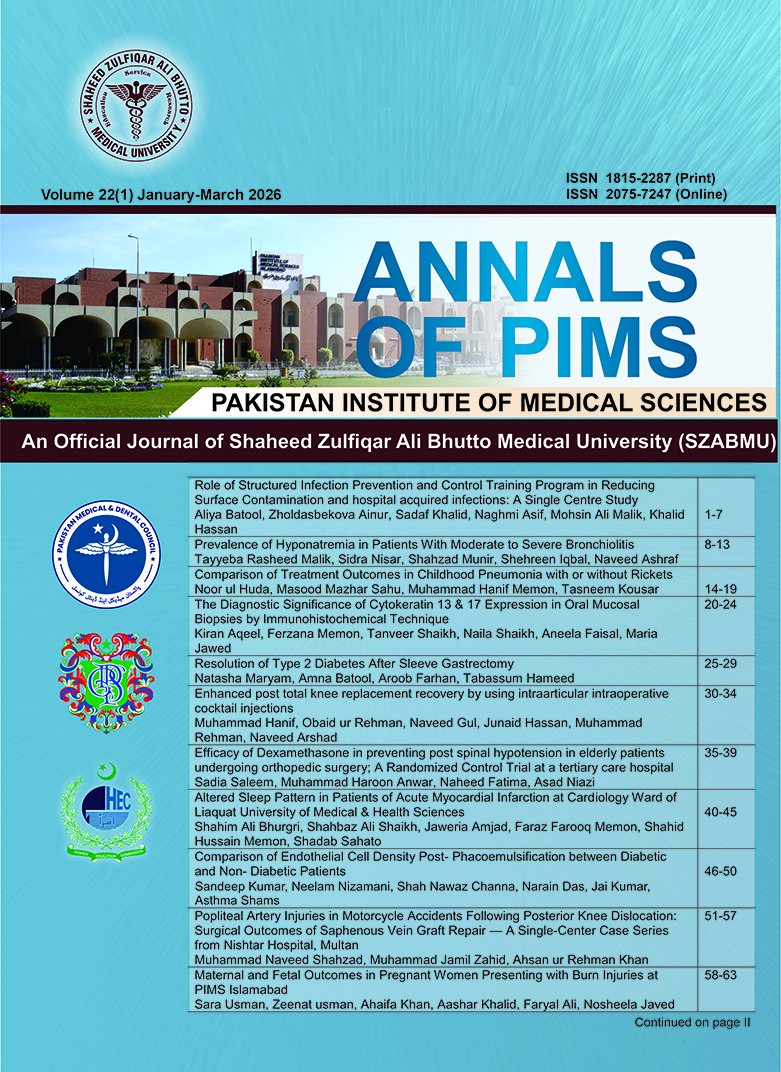
Role of Structured Infection Prevention and Control Training Program in Reducing Surface Contamination and hospital acquired infections: A Single Centre Study
DOI:
https://doi.org/10.48036/apims.v22i1.1626Abstract
Objective: To assess the impact of a structured IPC training program on reducing surface contamination and the frequency of HAIs. The findings aim to support effective infection control strategies and improved outcomes in healthcare settings.
Methodology: Retrospective interpreted time series (ITS) analysis of monthly environmental cultures from six critical areas of Tertiary care teaching hospital (June 2022 to Dec 2023) was conducted. Surface culture reports and HAI records were analyzed before and after IPC training implementation. Descriptive statistics and chi-square tests assessed the changes in surface contamination and HAI rates.
Results: Among 619 environmental samples from six critical areas, 32 (5.1%) showed microbial growth. Positive cultures rates declined significantly across study period from 11.9% to 3.1% and 1.7% following IPC program implementation (df = 2, p < 0.001). ICUs had highest contamination, predominantly Gram-positive cocci, including coagulase-negative Staphylococci. Hospital-acquired infections decreased in critical areas, with a significant shift after IPC implementation ( df = 3, p = 0.019).
Conclusion: There is a significant impact of implementation of infection prevention and control policies followed by regular and structured training sessions of healthcare professionals on surface bacterial contamination of critical areas and hospital associated infections in a tertiary care hospital.
Downloads
Published
Issue
Section
License
Copyright (c) 2026 Aliya Batool

This work is licensed under a Creative Commons Attribution-NonCommercial 4.0 International License.
This is an Open Access article distributed under the terms of the Creative Commons Attribution License (https://creativecommons.