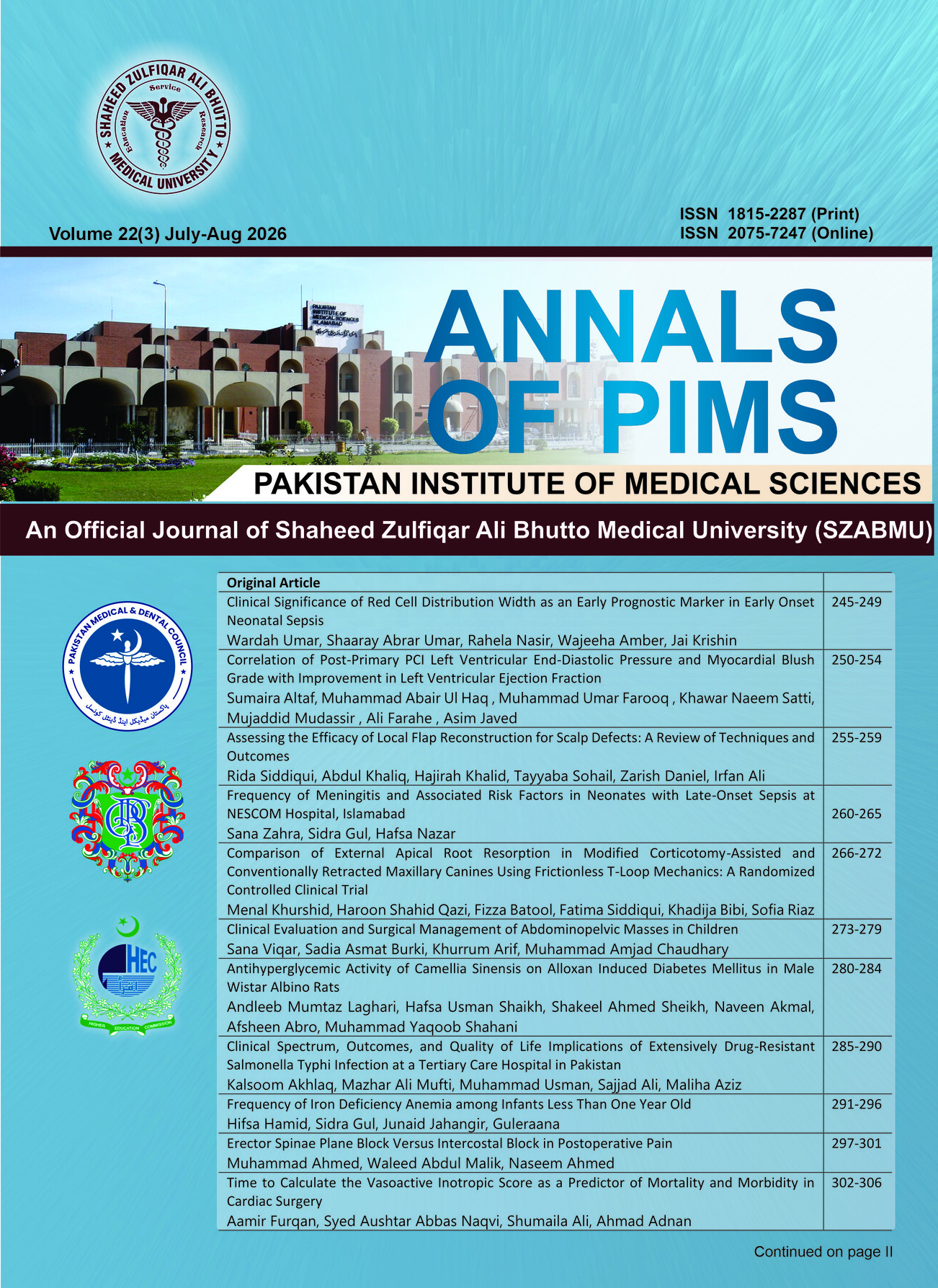
Antihyperglycemic Activity of Camellia Sinensis on Alloxan Induced Diabetes Mellitus in Male Wistar Albino Rats
DOI:
https://doi.org/10.48036/apims.v22i3.1603Keywords:
Camellia sinensis, Alloxan, Diabetic rats, Random Blood GlucoseAbstract
Objective: The present study is conducted to determine the antihyperglycemic effects of Camellia Sinensis in Alloxan induced diabetes mellitus in male Wistar Albino rat model.
Methodology: The present experimental study was carried out at the Department of Biochemistry, LUMHS Jamshoro from 29-9-2022 to 28-3-2023 and animals were kept at Sindh Agricultural University, Tando Jam. Laboratory investigations were performed at the Diagnostic and Research Lab, LUMHS. Rats were purchased from the animal house of Agriculture University, fulfilling the inclusion and exclusion criteria. Rats were housed in stainless steel cages with sawdust bedding. Animal housing and handling was in accordance to the NIH Guide (Care and Use of Laboratory Animals). A sample of n= 60 Albino Wistar rats were divided into negative control (A) and positive controls (B) and experimental group C (diabetic rats given Alloxan 120 mg/kg body weight (bwt) i.p. + C. sinensis 100 mg/kg bwt). Blood samples were collected from all 3 groups (A, B & C) through cardiac puncture after 4 weeks of experiment. Samples were taken in EDTA-containing tubes and plain tubes. Samples were centrifuged and sera collected for biochemical measurement – blood glucose (Fasting and Random).
Results: Mean RBG was significantly lower in the Camellia sinensis-treated group (323.15±9.91 mg/dL) than in untreated diabetic rats (499.05±34.29 mg/dL) (F=1570.9, p=0.0001). Similarly, mean FBG was significantly reduced in Group C (116.30±9.89 mg/dL) compared with Group B (146.30±37.14 mg/dL) (F=44.7, p=0.001), although values remained higher than those of the normal control group.
Conclusion: In conclusion, the Camellia sinensis exerts significant glucose lowering potential in Alloxan induced male albino rat model. The findings are of clinical significance for treatment of Diabetes mellitus
Downloads
Published
Issue
Section
License
Copyright (c) 2026 Andleeb Mumtaz Laghari, Hafsa Usman Shaikh, Shakeel Ahmed Sheikh, Naveen Nirmal, Afsheen Abro, Muhammad Yaqoob Shahani

This work is licensed under a Creative Commons Attribution-NonCommercial 4.0 International License.
This is an Open Access article distributed under the terms of the Creative Commons Attribution License (https://creativecommons.