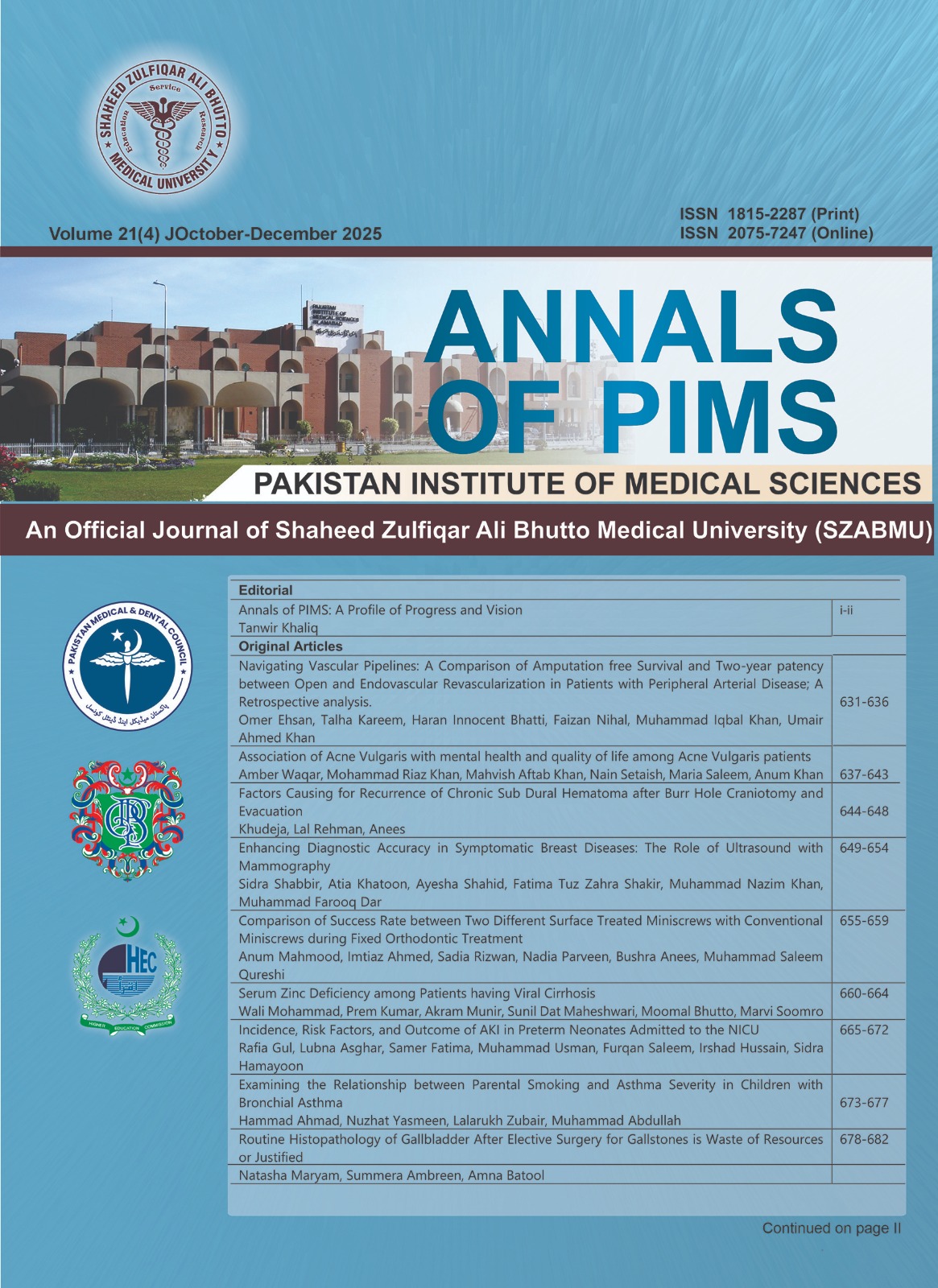
Navigating Vascular Pipelines: A Comparison of Amputation free Survival and Two-year patency between Open and Endovascular Revascularization in Patients with Peripheral Arterial Disease; A Retrospective analysis.
DOI:
https://doi.org/10.48036/apims.v21i4.1578Keywords:
Peripheral Vascular disease, endovascular revascularisation, lower limb bypass, Lower Extremity Amputation, amputation free survivalAbstract
Objective: Chronic limb-threatening ischemia (CLTI) represents the most severe form of peripheral arterial disease and is associated with high risks of limb loss and mortality. Both open surgical bypass and endovascular revascularization are established treatment options; however, comparative long-term outcome data from South Asian populations are limited. This study aimed to compare two-year primary patency and amputation-free survival between open surgical and endovascular revascularization in patients with CLTI.
Methodology: This retrospective observational cohort study was conducted at a tertiary care university hospital in Islamabad. Medical records of patients with CLTI who underwent lower-limb revascularization between January 2020 and January 2022 were reviewed. Patients were grouped according to the type of intervention: open surgical bypass or endovascular revascularization. Baseline demographics, comorbidities, procedural details, and outcomes were collected. The primary outcome was two-year primary patency, while the secondary outcome was two-year amputation-free survival. Kaplan–Meier survival analysis and appropriate statistical tests were used for comparison.
Results: A total of 109 patients were included, of whom 67 (61.5%) underwent surgical bypass and 42 (38.5%) underwent endovascular intervention. Two-year primary patency was 70.1% in the surgical group and 78.7% in the endovascular group (p = 0.091). Two-year amputation-free survival was 77.6% following surgical revascularization and 80.8% following endovascular intervention, with no statistically significant difference between groups (log-rank p = 0.092).
Conclusion: Both open surgical and endovascular revascularization provide comparable and acceptable two-year patency and amputation-free survival in patients with CLTI. Treatment decisions should be individualized through multidisciplinary discussion, considering anatomical factors, comorbidities, and patient-specific risks.
Downloads
Published
Issue
Section
License
Copyright (c) 2025 Omer Ehsan, Talha Kareem, Haran Innocent Bhatti, Faizan Nihal, Muhammad Iqbal Khan, Umair Ahmed Khan

This work is licensed under a Creative Commons Attribution-NonCommercial 4.0 International License.
This is an Open Access article distributed under the terms of the Creative Commons Attribution License (https://creativecommons.