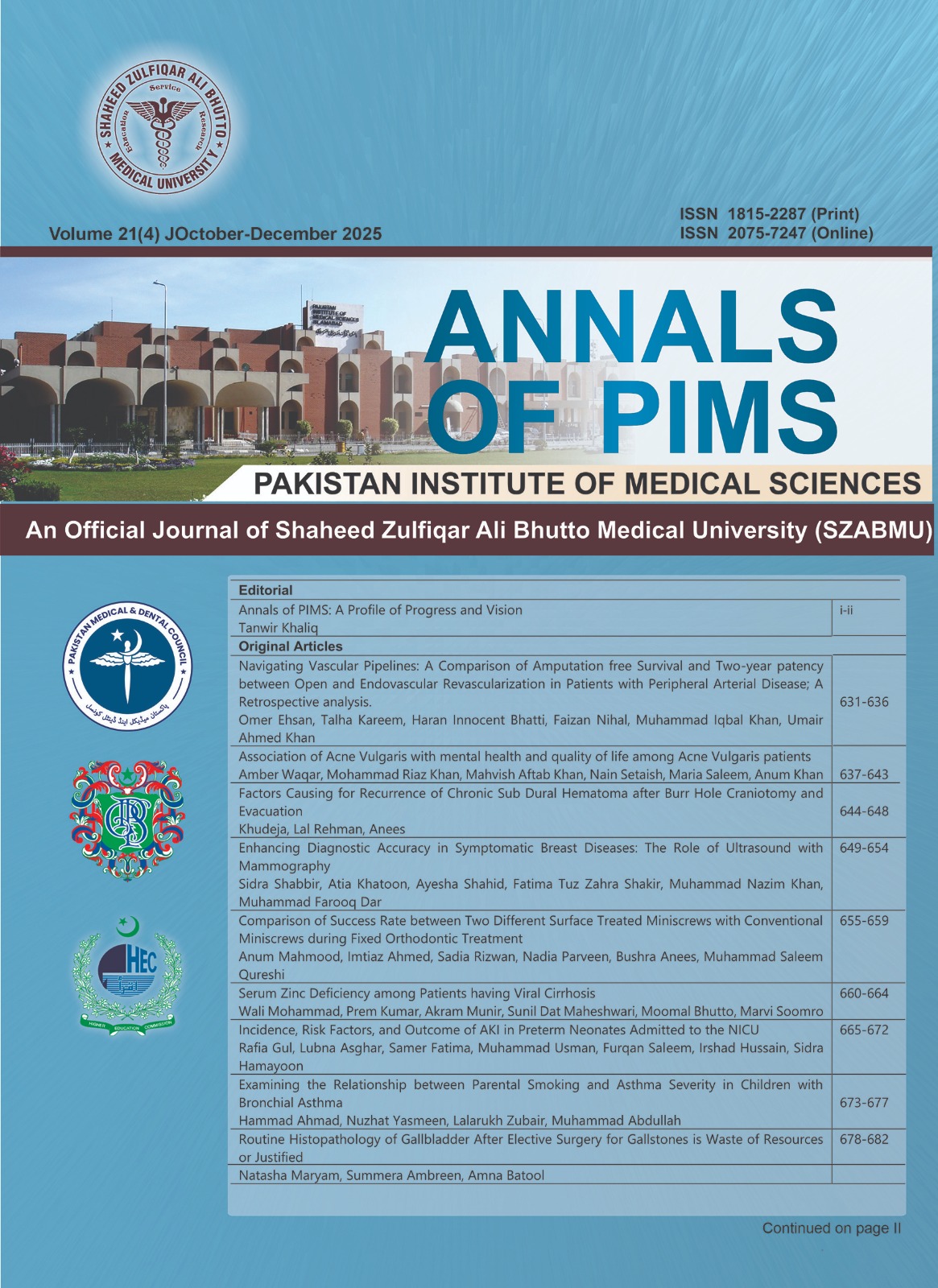
Comparison of Success Rate between Two Different Surface Treated Miniscrews with Conventional Miniscrews during Fixed Orthodontic Treatment
DOI:
https://doi.org/10.48036/apims.v21i4.1515Abstract
Objective: To determine the success rate between two different surface treated miniscrews and conventional miniscrews during fixed orthodontic treatment.
Methodology: This prospective, split-mouth, comparative clinical study was conducted at Orthodontics Department of Dr. Ishrat-ul-Ebad Khan Institute of Oral Health Sciences (DIKIOHS) Dow university Hospital karachi, from October 2024 to March 2025. Patient with fixed orthodontic therapy with requirement of absolute anchorage, patients with good oral hygiene and healthy periodontal status, aged 15 to 30 years of either gender were included. Individuals assigned to two groups, with Group A receiving sandblasted miniscrews on the right side and conventional miniscrews on the left, whereas Group B received acid-etched miniscrews on the right side and conventional miniscrews on the left side. The success was defined as the ability to maintain anchorage throughout orthodontic treatment without clinically detectable mobility. SPPS-26 version was used for data analysis.
Results: The success rate was significantly higher in Sandblasted miniscrew 80% as compared to 56.6% in conventional group (0.047). The success rate of Acid-Etched miniscrew was also found significantly higher 86.6% compared to conventional group 53.3% (p=0.010). However, the success rate was compared between Acid-Etched miniscrew and Sandblasted miniscrew, no significant difference was observed as p-value < 0.05.
Conclusion: Success rate of acid-etched surface miniscrews and Sandblasted miniscrews differed significantly. However, significant difference has been found in success rate between surface treated miniscrews with conventional miniscrews.
Downloads
Published
Issue
Section
License
Copyright (c) 2025 Anum Mahmood, Imtiaz Ahmed, Sadia Rizwan, Nadia Parveen, Bushra Anees, Muhammad Saleem Qureshi

This work is licensed under a Creative Commons Attribution-NonCommercial 4.0 International License.
This is an Open Access article distributed under the terms of the Creative Commons Attribution License (https://creativecommons.